
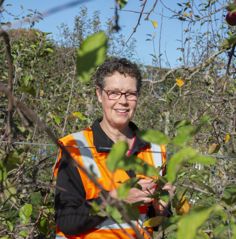
What made you look into orchard sanitation and FAR (forced ascospore release)? What was it about this subject that interested you?
I have always been interested in the environment and reducing our footprint, so I’d love to find more sustainable solutions to disease control, including effective alternatives to fungicide applications. What I like about sanitation is that it is effective in cleaning up many diseases, while FAR is fascinating because we’re using our knowledge of the scab disease cycle against the pathogen.
What was something surprising about the research that you discovered?
That the timing of the sanitation seems to be important for blackspot control. We now think that sweeping and mulching AS SOON AS all the leaves have dropped is important. This is probably because leaf breakdown early on will prevent the fungus from mating, which is the best way to reduce ascospores and reduce the chance that the fungus becomes resistant to fungicides.
What was something challenging that you encountered during the research?
In the sanitation trials it was great to see case study orchards adopting sanitation as a standard practice, and doing a great job removing leaves, fruit and branches from the orchard floor. However, it became challenging to show the effectiveness of sanitation in these orchards, because we didn’t have any no-sanitation control plots.
When did you start working at PFR? Can you please give us a brief summary of how you ended up at PFR?
I studied biology in Wageningen, the Netherlands, where I developed an interest in fungal genetics, ecology and plant pathology. I did my PhD in Adelaide on Phomopsis on grapevines, and then worked for a year on Rhizoctonia on cauliflower. I started working for HortResearch Hawke’s Bay in 2005 and am still in the same building, but after two mergers we’re now BSI. Since joining HortResearch, I’ve worked mainly on fungal apple diseases, some of my favourites being European canker, Elsinoe and blackspot.
Have you always been interested in plant/pest & disease research?
I have always been interested in finding out things, discovering things and understanding things, and I’ve always been interested in nature, plants, fungi and the environment. I also enjoy helping people, and I love the mix of field, lab and office work, as well as talking with growers about our research. So, discovering and developing practical solutions to problems involving plant diseases seems like the perfect job to me.
What’s been the most interesting piece of research you’ve completed at PFR?
Ooh that’s difficult to say! There have been so many interesting projects! But I’ve had the most fun when I’ve worked together with other people. For example: the Elsinoe work with Peter Wood and Brent Fisher; the many years working on European canker with Monika Walter, Rebecca Campbell, Brent Fisher, Vincent Bus and many students; working with Kerry Everett on lenticel rots; the molecular work with Jo Bowen and PhD students; and the scab work with Nari Williams, Peter Wood, Kerry Everett and David Manktelow.