
New Zealand pipfruit growers are set to benefit from a three-year research programme into an integrated approach to disease management.
Lower disease pressure and increased fungicide longevity are two key outcomes of the Smart & Sustainable research programme investigating innovative approaches to disease pressure.
Targeted and efficient crop protection practices are now being integrated at orchards across the country to deliver practical, grower-ready outcomes.
Senior Scientist Reiny Scheper says the research focuses on lowering background disease levels early, enabling growers to enter the season with less risk and more control.

“A key component is enhanced orchard sanitation. By carrying out sanitation practices at critical points in the season, growers can accelerate leaf litter breakdown and reduce the underlying sources of disease in the orchard.
“For example, by cleaning up leaf litter and dropped fruit from the orchard floor, we reduce the inoculum levels for scab (black spot), Alternaria, Elsinoe, bull’s eye rot and other storage rot diseases,” she says.
Alongside sanitation, the research is advancing a technique known as forced ascospore release. This involves using precisely timed bursts of water to trigger the release of disease spores under controlled conditions, effectively disrupting the natural disease cycle.
“Forced ascospore release (FAR), reduces scab even further, by irrigating the orchard floor and releasing the ascospores when they cannot infect,” Scheper explains. “Both methods reduce disease incidence, improve spray programme efficacy, and slow the development of fungicide resistance.”
The programme also incorporates improved monitoring tools, including DNA testing of leaves before visible symptoms appear and in-season assessment of disease levels at key times.
These insights can give growers a clearer understanding of what is happening in their orchard, allowing for more informed decision-making about when intervention is necessary.
Better visibility of risk and a greater control over timing, allows growers to focus their management efforts on optimising sprays and supporting more efficient use of resources.
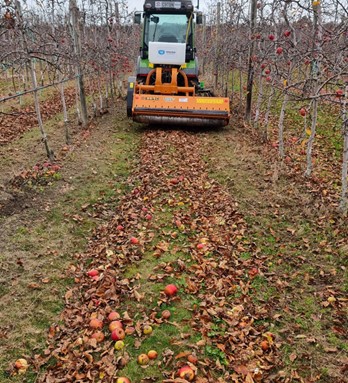
For growers, the key takeaway is simple. “Orchard sanitation is the key to lowering disease pressure; sweeping and mulching at 100 percent leaf fall is the most crucial and every application helps, even if it’s not perfect,” says Scheper.
This integrated approach supports the Smart & Sustainable programmes mission in lowering reliance on chemical controls and helping manage the risk of resistance while also aligning with market expectations around sustainable production, says New Zealand Apples and Pears R&D Programme Manager Dr Rachel Kilmister.
“Programmes such as this contribute to maintaining New Zealand’s strong market access position, by demonstrating robust, science-based pest and disease management.
“International regulators and trading partners increasingly expect evidence-based assurance that New Zealand’s market access systems effectively manage biosecurity and disease risk, so it is incredibly invaluable to have tools like orchard sanitation and forced ascospore release backed by credible data.”
Further research is now expected to focus on refining the timing of sanitation practices, improving disease detection tools, and exploring more efficient ways to apply forced ascospore release in commercial orchards.